Copperhead Engineers
Copperhead Engineers
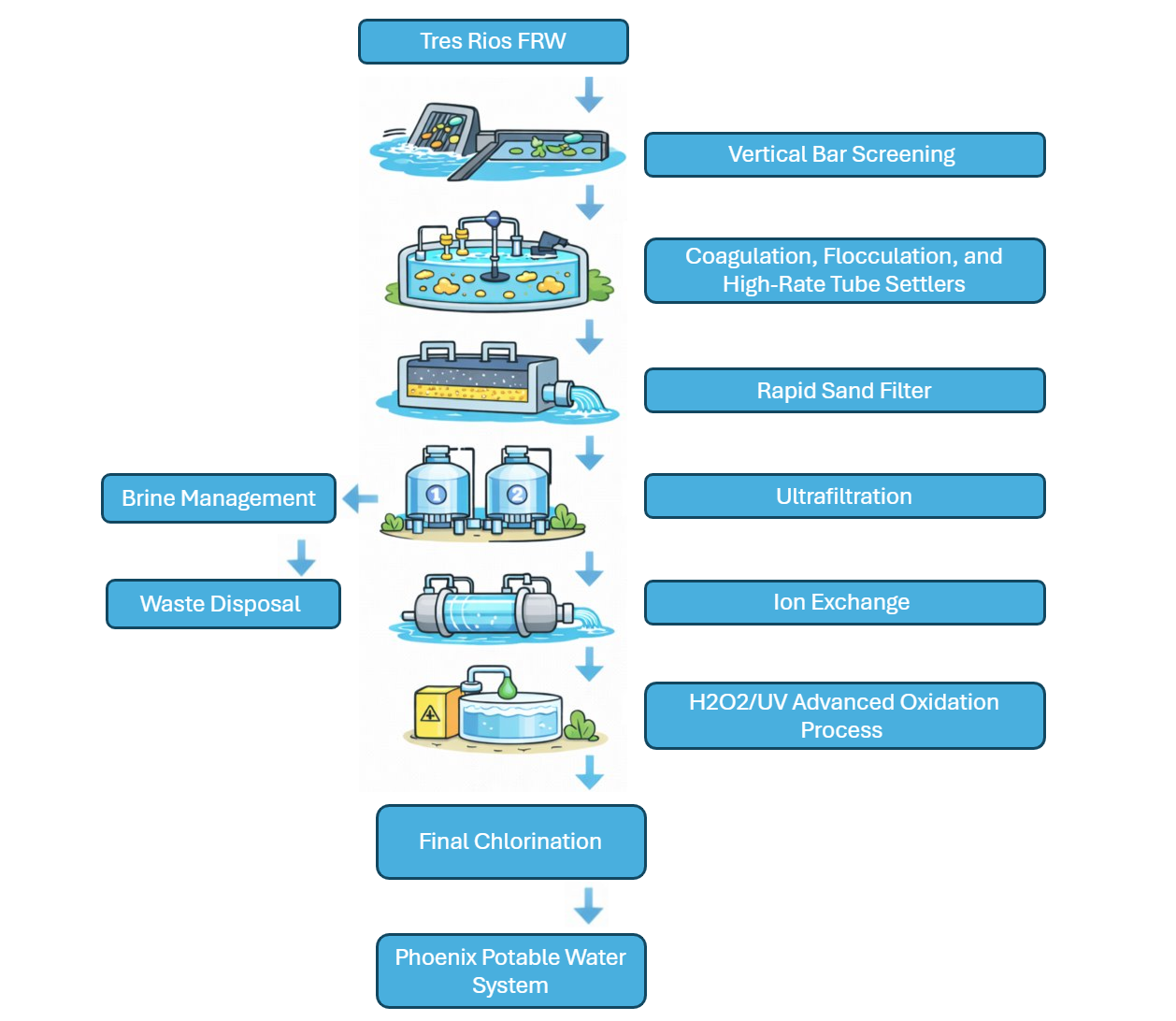
The team first developed a flowchart outlining all individual processes required for advanced water purification, including coagulation/flocculation and the three primary physical separation processes.
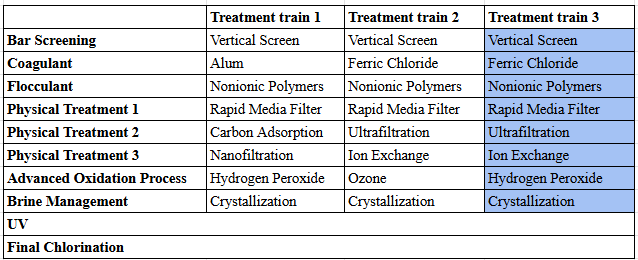
Following this, a decision matrix was created for each process, with 3–4 methods evaluated per matrix. Each method was assessed across five categories: environmental impact, energy efficiency, operational and capital cost, operational flexibility, and land use. Scores from 1 to 3 were assigned for each category, based on research and relative comparisons among the methods.
Once the top 1–2 methods were identified for each process based on their scores, three treatment train alternatives were developed. For each alternative, the scores of its selected processes were aggregated across all evaluation categories. The alternative with the highest overall score was then chosen as the treatment train for the designed facility.
 Design Matrix and Treatment Alternatives
Once the best alternative was selected the engineering team started the calculations required for the treatment train design process. Many of the calculations came from engineering textbooks used in classes along with outside research. A number of the values are assumed due to the team not having all of the water quality data.
The team started off by calculating the number of bar screens required for removing the large solids entering the facility. Next the daily dose of Ferric Chloride and non-ionic polymers need to be calculated, these values ended up being assumed since there was no Jar test.
Once those doses were found, the size of the high rate sedimentation basin needed to be calculated and it was determined that a tube settler was best for removing the most Total Suspended Solids (TSS) as possible. The Rapid media filter removes all remaining solids and from the system, and the area of the tank was calculated.
Then the number of units for ultrafiltration and ion exchange units were calculated based on the TSS and Total Dissolved Solids (TDS) needing to be removed from the system,
Lastly the dose of hydrogen peroxide and chlorine were calculated for the final TDS and pathogen barrier in the system. Click for more to see values and calculations
 Treatment Train Hand Calculations
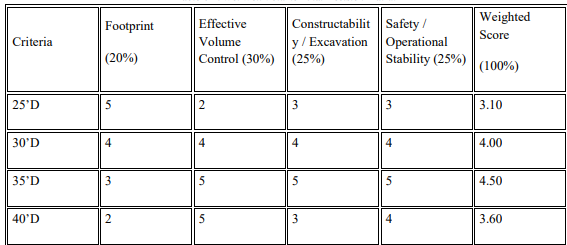
Wet well dimensions were selected using a weighted decision matrix that considered footprint, effective storage volume, constructability, and operational stability. The 35-foot diameter option received the highest overall score and was chosen as the preferred design, offering a strong balance between hydraulic performance and ease of construction. Ductile iron pipe (DIP) was selected over prestressed concrete cylinder pipe (PCCP) based on constructability, flexibility, and compatibility with the pump station and site layout. DIP allows for easier alignment adjustments and improved integration with mechanical components such as valves and pump connections.
Wet Well Decision Matrix Pipe Decision Matrix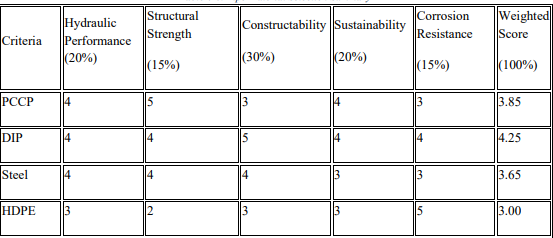
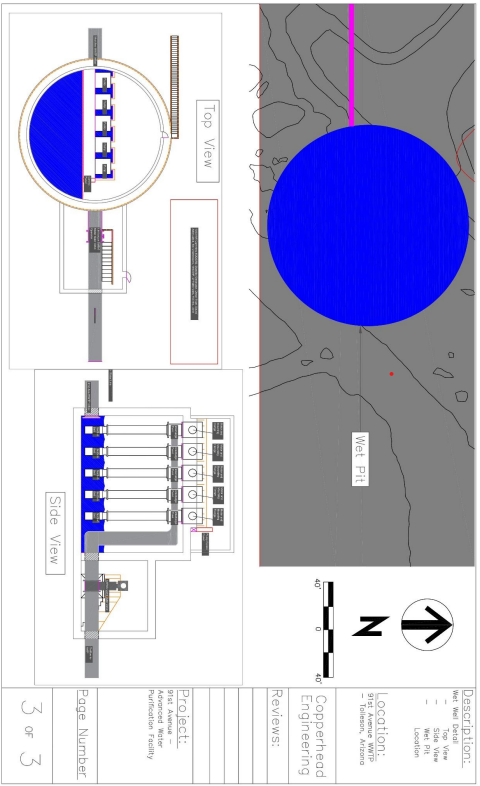
The pump station is designed with a wet pit (open sump) layout that includes four vertical turbine pumps operating simultaneously, along with one standby unit (4 duty + 1 standby) to maintain reliability during peak demand and maintenance periods. Each pump provides roughly 6,944 gpm and is fitted with a variable frequency drive (VFD) to optimize flow regulation and improve energy efficiency.
Flow equalization is achieved through an on-site equalization (EQ) tank, which helps manage variations in influent flow and supports consistent pump operation.
Each pump discharge ties into a shared 42-inch header, which is fitted with isolation and check valves to enable independent pump operation and overall system control.
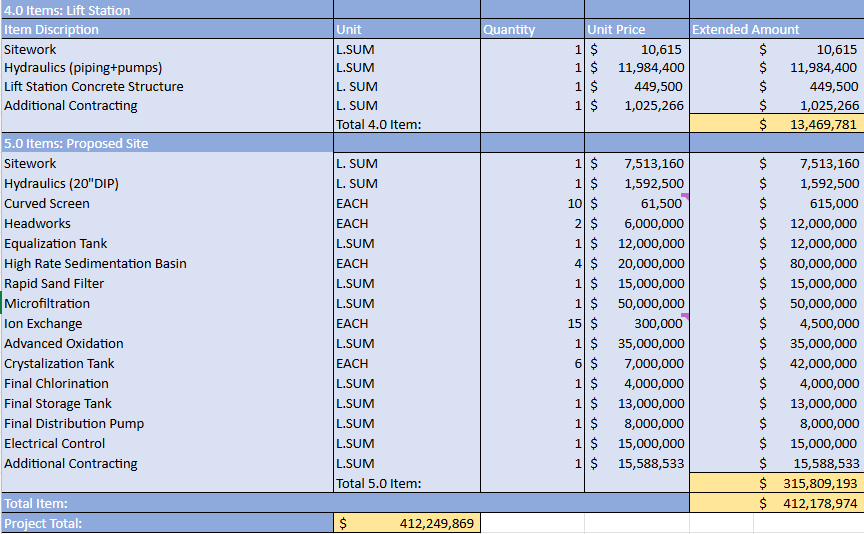
The total project cost, including lift station construction, treatment processes, site development, and engineering services, is based on an Opinion of Probable Construction Cost (OPCC) using historical bid and RS Means data. The estimated construction cost is $329.28 million, with engineering services at $82.9 million, for a total capital cost of $412.18 million. Annual operation and maintenance costs are estimated at $13.2 million (about 4% of construction cost).