
Decision Matrices
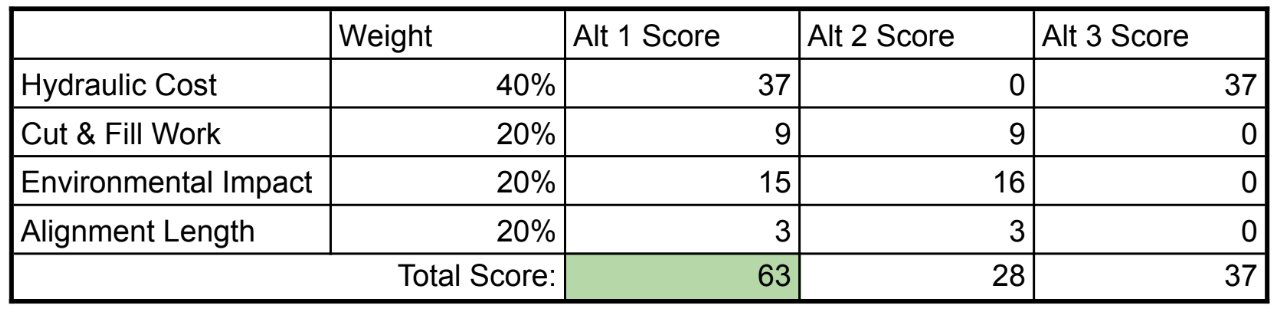
A map of the three alternative alignments examined in this decision matrix are available in Figure 1‑2 of the final design report. Alternative 1 is provided by the owner. The team decided to analyze two other alternatives to ensure that the owner had a full understanding of the options for this project.
Alternative 2 is intended to reduce the overall length of the alignment and reduce the number of trees removed for construction. However, alternative 2 intersects with the FEMA flood plain in the area, which greatly increases the cost of hydraulic infrastructure. Alternative 3 is intended to increase the overall length of the alignment, which would allow for further development of the land surrounding the roadway. However, alternative 3 would require much greater tree removal for construction.
The hydraulic cost is analyzed with respect to the amount of flow intersecting the proposed alignment, the cut & fill work is analyzed with respect to the existing grade changes along each alignment, the environmental impact is analyzed with respect to the amount of trees removed for construction, and the alignment length is analyzed with respect to the overall length of the proposed alignment. The decision matrix below in the table below examines each alternative alignment with respect to each category discussed above. Alternative 1, with the highest score, shows to be the most ideal alignment option.
The two alternatives considered for the structural section are detailed below.
- Alternative 1 – 12-inches of aggregate base course on 12-inches of scarified & compacted subgrade
- Alternative 2 – 2-inches of aggregate base course on 6-inches of cement treated subgrade on 12-inches of scarified & compacted subgrade
Both alternatives will pave 4.5-inches of asphalt concrete. Using the processes in section 3.4.5 of the final design report, the structural number for alternative 1 is 4.25. The structural number for alternative 2 is 4.29. The required structural number is 4.23.
The construction cost is analyzed with respect to the prices of each alternative discussed in section 5.2 of the final design report. The structural strength is analyzed with respect to the structural numbers discussed above. The decision matrix in the table below examines each alternative alignment with respect to each category discussed above. Alternative 2 is selected as the preferred alternative. Per our client's request, both alternatives are provided in the plan set.

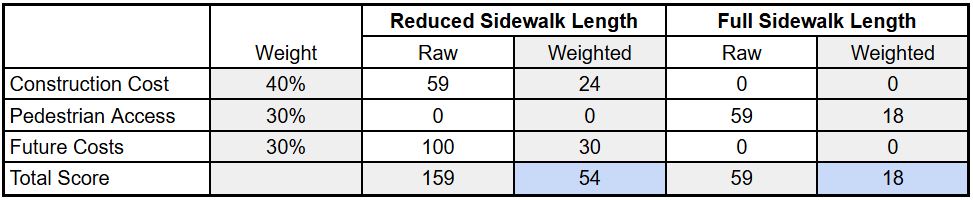
The proposed alignment is largely surrounded by areas with few pedestrians or open space that has not yet been developed. The only area generating pedestrian traffic is the proposed development. Because of this, the length of the sidewalk may be reduced from the full alignment length to only serve the proposed development, from 7026 feet to 2883 feet.
The construction cost is analyzed with respect to the prices discussed in section 5.2 of the final design report. The pedestrian access is analyzed with respect to the amount of the alignment that is served by the sidewalk. The future costs are analyzed with respect to the cost to build out the rest of the length of sidewalk in the future. The decision matrix in the table below examines each alternative alignment with respect to each category discussed above. The highest scoring alternative is the reduced sidewalk length.